
Jones County Projected vs Actual
North Carolina DAC uses the labels Projected Release Date and Actual Release Date for different facts. A projected date is a calculation based on the judgment, sentence structure, jail credit, and earned time currently entered. An actual date is the recorded release transaction for a sentence episode. A projection that has passed must never be converted into a release claim. Look for the actual field and a consistent incarceration or service status.
A pretrial Jones County detainee normally has no sentence-based release date. Bond can be set, changed, or satisfied, and a judge may dismiss a charge or enter another order. Staff still must receive the authority, confirm identity, check other commitments, and complete processing. Another warrant, detainer, or transfer can keep custody in place. The Jones County court file explains legal authority, while the jail record shows physical departure.
A sentenced inmate can have a computed date, but custody type controls where it appears. Jones County Jail records govern a local jail sentence. DAC OPI governs a person received into state prison. A Jones County arrest alone does not create a DAC inmate record.
Find Jones County Projected Release Dates
Begin with the last known custodian. A person held at the Jones County Detention Center may be awaiting court, serving a local term, or waiting for transfer. A state prisoner is assigned through the North Carolina Division of Prisons, usually outside Jones County because no DAC prison was found in the county. Search systems should follow that custody split.
- Confirm whether the person is in the county jail, state prison, federal custody, or another jail. Do not rely on a general name search.
- For state prison, open the DAC Offender Public Information search. Prefer the seven-digit offender number.
- Match identity, conviction county, offense, admission history, sentence number, and docket before reading a date.
- Read Projected Release Date and Actual Release Date as separate fields. Check Inmate Status and post-release status too.
- For a Jones County jail sentence, call detention and obtain the existing sentence or release calculation record. Use the clerk's judgment to confirm the legal terms.
- If fields conflict, document the offender number, sentence number, docket, and disputed label before contacting the custodian.
The Jones County released-inmate record path covers the full records-request and court-check sequence. DAC also offers an Inmate Release Search, but that tool lists state-prison releases by destination county and month. It is not a projected-date calculator and does not show who may bond out of the Jones County jail.
Note: Search the full DAC history because an old actual date can coexist with a later admission or a new sentence episode.
Jones County Felony Release Math
The calculation starts with the court judgment. Under N.C.G.S. § 15A-1340.13(d), a person serving an active structured felony term serves the minimum except for stated legal exceptions. Earned time may reduce the maximum, but not below that minimum. The minimum and maximum come from the applicable sentencing framework. Admission credit, sentence order, and DAC's calculations then shape the displayed projection.
The common “85 percent” phrase needs this North Carolina context. DAC explains that structured sentencing for offenses committed on or after October 1, 1994 ended traditional parole and requires service of the full minimum and at least 85 percent of the maximum, followed by felony post-release supervision. It does not mean every state prisoner or county detainee serves exactly 85 percent of one announced number. The minimum is the ordinary floor, and special sentence regimes require their own rules.
The correctional earned-time statute authorizes DAC rules for credit rates and circumstances. Credits are agency calculations. Work or program participation, behavior, and sentence administration can affect authorized credit, but no outsider should assign a personal countdown from a few public fields. Older Fair Sentencing cases, impaired-driving terms, life sentences, revocations, and mandatory provisions can operate differently. The statutory felony minimum and earned-time boundary are visible in this official North Carolina statute source.
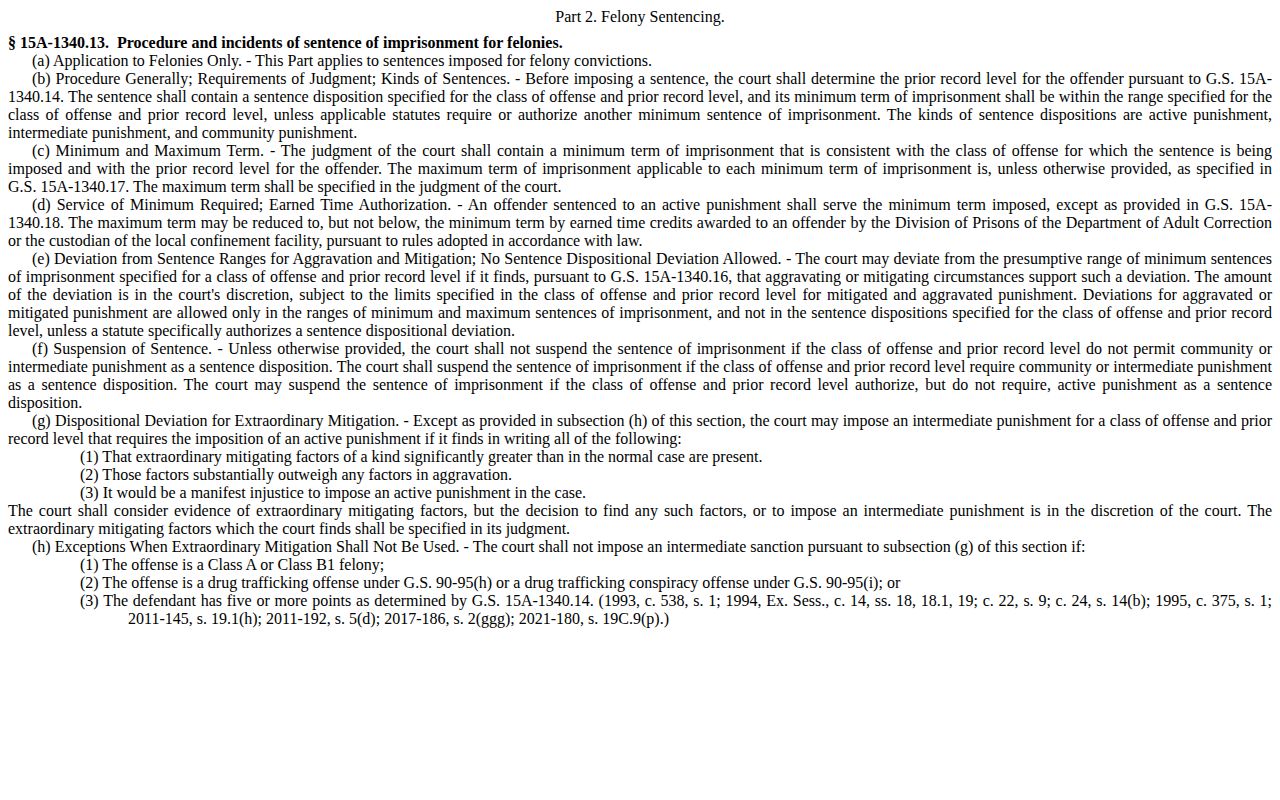
The statute supports the minimum-term floor and explains why a flat percentage is not a safe release-date method.
Why Jones County Release Dates Change
A changed projection is not by itself proof of misconduct or a data error. DAC recalculates when the sentence facts or credit record change. Courts can also amend, vacate, or replace a judgment. A new case can make a term consecutive. A detainer may not change the end of one sentence, but it can change whether the person enters the community at that point.
| Factor | Possible effect | Best source |
|---|---|---|
| Earned time or program assignment | Authorized credit changes the calculated maximum-side date | DAC sentence and credit record |
| Discipline or credit restoration | Loss or return of credit can move the projection | DAC administrative record |
| Jail credit correction | Newly entered pre-sentence credit changes the computation | Judgment and DAC calculation |
| Resentencing or corrected judgment | Terms, order, or legal basis can change | Jones County court file and DAC record |
| New consecutive sentence | Custody continues after the first sentence segment | Complete sentence chronology |
| Parole action in an eligible case | Commission action affects a legacy or special release path | Commission record and DAC actual date |
| Other-agency hold | Departure from DAC or jail may become a transfer | Custodian's movement record |
Administrative data correction, changes in law, and appellate action can also alter a field. Record what the system showed on the search date. If a later source differs, the earlier capture may simply reflect the calculation then in force.
Confirm Jones County Actual Release
Use a hierarchy. In DAC OPI, an Actual Release Date plus inactive or service-expired incarceration status is stronger than a future projection. Then obtain the release record from the custodian if manner or destination matters. The court judgment explains authority but not the exact exit time. A complete answer may therefore need both the custody event and the matching case.
The Jones County VINELink release check can provide notice of a pending custody change. It is not final proof. Verify the source agency and time, then ask whether the event was release to the community or transfer. If a Jones County detainee moved to DAC, follow the state record. If the person moved to another jail or federal authority, continue with that custodian.
When an OPI record seems wrong, send DAC the offender number, sentence number, docket, disputed field, and the competing official document. If the judgment itself is wrong or was amended, use the clerk or court process. One agency ordinarily cannot rewrite another agency's record.
Note: A release from prison into mandatory supervision ends confinement, but it does not mark unconditional discharge from correctional authority.
Jones County Jail Earned Time
North Carolina misdemeanor sentences use a separate credit rule. N.C.G.S. § 15A-1340.20(d) permits earned-time credit under DAC or local-custodian rules and § 162-60. Under that subsection, the combined award is limited to four days per month. A local Jones County jail term should not be calculated by copying the structured-felony percentage.
The jail custodian applies the authorized rule to the actual sentence and credits. The judgment may show the term and jail credit, while the jail's record supplies the working computation and actual release event. Impaired-driving sentences and other special provisions may follow different rules. Ask for the existing calculation rather than requesting that staff create a new prediction.
Jones County's public detention page does not publish an online sentence calculator, projected-date field, release schedule, or weekend processing rule. That absence must remain clear. The safe route is the detention information line and a precise records request, paired with the court judgment. An estimated calendar date made without the local credit record can be wrong even when the stated sentence length is known.
Jones County Post-Release Transition
Under N.C.G.S. § 15A-1368.2, many structured felony terms move from prison into mandatory post-release supervision before the maximum term fully expires. The statute generally keys that prison release to the maximum less a supervision component, with different components for felony classes and special treatment for certain offenses. The exact current statute and sentence must control.
This transition explains a record that shows inactive incarceration and active Probation/Parole/Post Release Status. The person has left prison but has not reached full sentence discharge. DAC Community Supervision manages the community phase, and the Post-Release Supervision and Parole Commission sets the applicable conditions. A projected prison-release date therefore may mark the start of supervision, not the end of every correctional obligation.
Traditional discretionary parole belongs chiefly to eligible older sentences and a limited modern category described by the Commission. First eligibility depends on offense date, sentence regime, exclusions, and the judgment. A monthly parole result still does not establish the physical release date. Use DAC Actual Release Date and status after Commission action.
Jones County Release Date Boundaries
A Jones County date can refer to several different events. A bond date is not necessarily the time bond was satisfied. A court order date is not the jail exit time. A DAC projected date is not an actual release. An actual prison release may begin supervision. A county release entry marked transfer means custody continued somewhere else.
Federal and immigration custody use separate systems. A person arrested locally on a federal matter may never have a DAC projected date. A county detainee with an immigration detainer may leave the Jones jail and enter ICE custody. BOP and ICE records must be read within their own coverage, and neither an empty local roster nor a past county date resolves the later custodian.
For any disputed date, write down the full recorded name, offender or booking number, case number, source, field label, and search date. Then compare the custodian's event with the legal order. This method is slower than adding sentence length to a calendar, but it respects the actual North Carolina computation and the small Jones County jail's transfer role.
Historical proof may require an agency-produced record rather than a screenshot. Dynamic OPI fields can change from projected to actual, active to inactive, or one sentence episode to another. Preserve the earlier search date and wording, then attach the newer official status. That chronology shows what each source reported without treating a routine update as proof that the older display was false.